

A 12V power socket panel mount works well when the chosen surface has a suitable cutout and enough space behind it for the socket, terminals, and wiring. A mounting plate helps organize one or more outlets on a flat panel. A surface-mounted housing is worth considering when rear clearance is limited, provided its footprint and cable route fit the installation.
The dash is an installation location, rather than a separate mounting method. A dash or console can accept a panel-mounted socket, a plate-mounted assembly, or a suitable external housing. Start with the available space and the connected accessory before choosing the format.
1. Compare the Three Mounting Formats
1.1 Individual Panel-Mount Socket
A socket fitted directly through a panel leaves a compact front face. This format suits a single outlet or a replacement where the existing opening can be checked against the selected socket.
Rear access matters as much as the opening. The retaining hardware must fit the panel, and the terminals need space for insulated connections and a supported cable route. A socket that fits the hole can still be too deep for the location.
1.2 Socket With a Mounting Plate
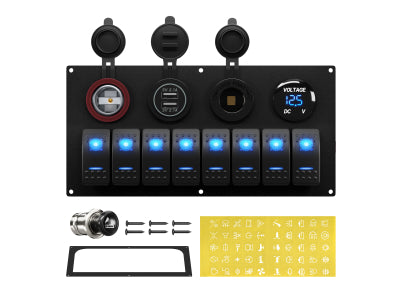
A mounting plate provides a defined front layout and fixing points. Single-outlet plates suit a dedicated accessory position; combination plates can place a 12V outlet beside USB charging ports.
A flat plate does not create an enclosure behind the panel. The socket bodies still need clearance, and the installation may require openings beneath the plate. Overall plate dimensions, socket cutouts, and screw positions are separate measurements.
1.3 Surface-Mounted Housing
A surface housing places the socket body in an external enclosure instead of relying entirely on space behind the mounting surface. This can help with a shallow console or an RV cabinet where a recessed outlet is impractical.
The housing needs secure fixing, a protected cable entry, and room for the connected plug. Surface mounting may reduce the size of the opening required for the socket body, but it does not mean a drill-free installation. Check the specific enclosure instructions before ordering.

2. Check the Space Behind and in Front
Before cutting, separate the fit check into four areas:
- Panel opening: match the cutout shape, diameter, and any anti-rotation feature to the product drawing.
- Panel thickness: confirm that the retaining nut, clips, or fixing hardware can secure the socket.
- Rear clearance: allow for the socket body, terminals, connectors, and cable bend.
- Front clearance: allow for the inserted accessory plug, its cable, and any cover that must open.
Do not confuse the socket's internal plug opening with its mounting cutout. For example, the DAIER DR-Y5 covered accessory socket lists a 26 mm mounting hole. That dimension belongs to this product; it is not a universal hole size for 12V sockets or USB modules. Check the current drawing and actual part before cutting.
A front-mounted outlet should remain usable with its plug connected. In a vehicle, keep the assembly and cable clear of controls, pedals, airbags, and moving trim. In an RV cabinet, check that doors and drawers can still close. Follow the vehicle or vessel documentation before modifying any panel.

3. Choose the Outlet for the Connected Device
An accessory socket accepts a compatible plug; a dedicated USB charger provides USB charging ports. These functions are different even when both products use a round panel opening.
Keep an accessory socket when the equipment requires that plug interface. Choose dedicated USB charging when phones, navigation devices, or other USB equipment are the main load. Charging performance depends on the charger, device, and cable specifications, not on the mounting style.
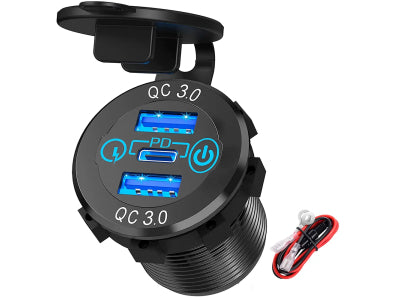
The DAIER dual QC3.0 USB charger and accessory socket panel combines both functions on one plate. This is a useful layout option when both interfaces are needed and the panel space fits. For charging-port selection, see the 12V USB charger buying guide.
4. Match the Installation Location to the Exposure
A cover helps keep debris out while the socket is unused. It does not by itself establish an IP rating or confirm protection with a plug inserted.
For an exposed boat console, open vehicle, or exterior RV compartment, check the selected product's documented environmental limits, the rear connections, and the cable entry. A location protected from direct spray may require a different arrangement from an exposed deck. Do not treat a product's marine label as proof of suitability for every onboard location.
5. Keep Mounting and Circuit Protection as Separate Checks
A mounting plate or enclosure does not establish the correct wire size, fuse value, or allowable accessory load. Confirm the socket, plug, wiring, supply, and protection as a complete circuit using the relevant equipment instructions.
Isolate the supply according to the vehicle or vessel procedure before working on wiring. Stop if existing connections show melting, heat damage, or repeated fuse failure. The guide to a 12V accessory socket that is not working covers the fault-checking sequence before replacement.
6. Related DAIER Products
Compare the Cigarette Lighter & Parts collection after settling the mounting format.
- Direct fit candidate: DR-Y5 covered accessory socket — an individual panel-mount option for compatible accessory plugs.
- Alternative socket function: DR-Y6 socket — the product listing supports both accessory plugs and lighter use; confirm the intended plug and installation fit.
- Mounting-plate format: DS1011L with DS2 mounting plate — a single-outlet assembly with a defined front plate.
- Functional upgrade: Dual QC3.0 USB charger and accessory socket panel — a combined plate for projects needing both charging and an accessory outlet.


