

Adding aftermarket accessories to your car, boat, or camper van is one of the most rewarding DIY projects you can tackle. Whether you are wiring up a new LED light bar on your Jeep, installing a water pump in your RV, or hooking up a fishfinder on your fishing boat, you need a safe way to power these devices.
Connecting every wire directly to your main battery quickly turns into a dangerous, tangled mess. That is where a 12V fuse box comes in.
In this buying guide, we will cover what a 12V fuse box does, why you need one, how it compares to simple inline fuse holders, and how to choose the right number of circuits for your build.

What is a 12V Fuse Box?
A 12V fuse box (also commonly called a 12V fuse block) is a central distribution hub for your vehicle's auxiliary electrical system.
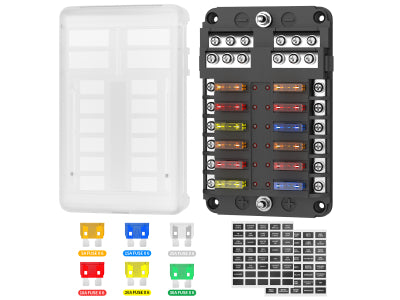
It takes one thick power wire from your battery and splits it into multiple smaller protected circuits. Each circuit holds a blade fuse (such as an ATO or ATC fuse) that matches the power draw of the specific accessory connected to it.
Think of it like the main breaker panel in your house, but built specifically for 12-volt direct current (DC) power in cars, trucks, RVs, and boats.
Why Do You Need a 12V Fuse Box for Your Project?
If you only install one small accessory, you might get away with connecting it directly to your battery with an inline fuse. But as soon as you add two, three, or more items, a dedicated 12V fuse box becomes essential for three reasons:
1. Safety and Fire Prevention
Wires can pinch, rub against sharp metal, or overheat. If an un-fused wire shorts out against your vehicle frame, it can melt in seconds and cause an electrical fire. A fuse box holds a safety fuse for every circuit that instantly blows (melts) to cut power before damage occurs.
2. Clean and Organized Wiring
Without a fuse box, your battery terminals end up stacked with dozens of messy ring terminals. A fuse box lets you run one main heavy-gauge wire from your battery to a single clean location. All your accessories then connect neatly to the fuse box.
3. Easy Troubleshooting
If an accessory stops working, you do not have to crawl under the vehicle to trace wires. You simply pop open the fuse box cover and check the fuses. Many modern 12V fuse boxes even feature LED warning lights that glow red next to the exact fuse that blew!

Fuse Holder vs. Fuse Block vs. Fuse and Relay Box
Before choosing a fuse box, it helps to understand the different power distribution options available for DIY projects:
In-Line Fuse Holder
An inline fuse holder protects a single wire circuit. It sits directly on the power wire between the battery and one accessory.
Best for: Adding just one simple device, like a single CB radio or small USB port.
12V Fuse Block (Fuse Box)
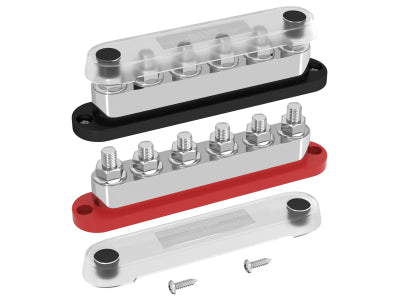
A 12V fuse block handles multiple circuits (usually 4 to 12) on one central plate. Most quality marine and automotive models include a built-in negative bus bar, meaning both positive and negative wires connect directly to the fuse block rather than grounding to body metal.
Best for: Adding 3 or more accessories in a car, camper van, or fiberglass boat.
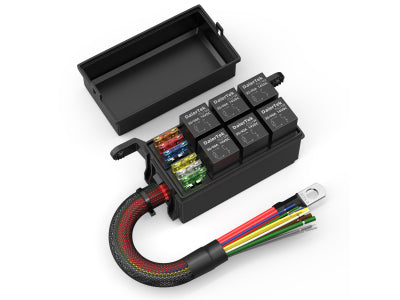
Fuse and Relay Box
A Fuse and Relay Box combines blade fuses with automotive relays in one sealed enclosure. Relays allow low-power switches to safely control high-power equipment.
- Best for: Complex off-road or truck setups running heavy electrical loads like winches, high-wattage LED light bars, horn kits, and electric radiator fans.
 |

|
 |
| In-Line Fuse Holder | 12V Fuse Block | Fuse and Relay Box |
How Many Circuits Do You Need? (4, 6, 8, vs. 12 Circuit)
The most important decision when buying a 12V fuse box is choosing the number of available circuits (switch/accessory connections).
Here is a simple breakdown comparing the four most popular sizes:
| Fuse Box Size | Ideal Applications | Typical Accessories Connected | Pros & Cons |
| 4 Circuit | Kayaks, UTVs, Small Fishing Boats | Navigation lights, small depth finder, USB port, bilge pump |
Pros: Ultra-compact, fits anywhere. Cons: Fills up almost instantly. |
| 6 Circuit | Jeeps, Truck Beds, Overland Rigs | Pod lights, rear camp lights, fridge, air pump, USB charger, radio |
Pros: The most popular DIY size; fits small to mid setups. Cons: Limited expansion room. |
| 8 Circuit | Center Console Boats, Small Camper Vans | Deck lights, anchor light, fishfinder, freshwater pump, stereo, VHF radio |
Pros: Great balance of size and capacity. Cons: Harder to find than 6 or 12-circuit models. |
| 12 Circuit | Full Camper Vans, RVs, Large Off-Road Rigs | Interior puck lights, fridge, water heater, fans, Starlink, water pump, lights |
Pros: Plenty of room for future additions. Cons: Requires a larger flat mounting area. |
Golden Rule for Choosing Circuit Size:
Count the total number of 12V accessories you plan to install today, then add at least 2 to 4 extra open circuits for future upgrades.
If you think you need 4 circuits today, buy a 6-circuit or 8-circuit fuse box. You will almost certainly add more gear later!

Key Features to Look For When Buying a 12V Fuse Box
To make sure your installation stays safe and durable, look for these specific features:
1. Built-In Negative Bus Bar
In boats (especially fiberglass or aluminum) and modern vehicles with sensitive body electronics, grounding back to a central ground point is vital. A 12V fuse box with a grounding negative bus bar lets you attach all positive and negative wires in one neat panel.
2. High Current Ratings
Check two ratings before buying:
- Max Amperage Per Circuit: Usually rated at 30A per circuit.
- Max Amperage For Entire Box: Usually rated between 100A and 125A total.
Make sure the combined amp draw of your running accessories does not exceed the total box rating.
3. Clear Protective Cover with Clip Latches
A clear polycarbonate cover keeps dust, water droplets, and accidental metal touches away from live fuses while letting you visually inspect fuse conditions easily.
4. Marine-Grade Corrosion Protection
If installing on a boat or open off-road vehicle, choose a marine-rated 12V fuse box. Look for tin-plated copper buses and stainless steel mounting hardware that resist rust and salt fog corrosion.
Common Fuse Box Buying Mistakes to Avoid
1. Buying a Box Without a Ground Bus: If you buy a "positive-only" fuse box for a fiberglass boat or van interior, you will still have to buy a separate negative distribution block to connect your ground wires.
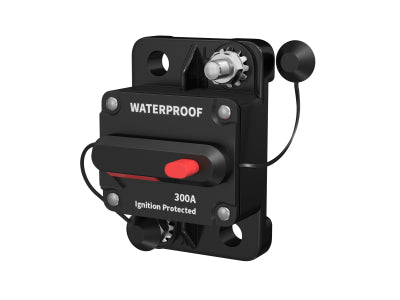
2. Under-Sizing the Main Feed Wire: Running a thin power wire from your battery to a 12-circuit fuse box will cause voltage drop and heat. Always run thick wire (like 4 AWG or 6 AWG wire) protected by a main circuit breaker near the battery.
3. Ignoring Amperage Limits: Plucking a high-draw 40-amp compressor into a fuse block slot rated for 30 amps maximum will melt the fuse socket. Use a dedicated relay or high-amp circuit breaker for heavy motor loads instead.
Final Thoughts
Investing in a quality 12V fuse box is the smartest decision you can make for any automotive, marine, or RV electrical project. It protects your expensive equipment, keeps your wiring clean, and makes troubleshooting simple when you are out on the trail or water.
Ready to start your electrical build? Check out our complete lineup of 12V Fuse Boxes & Blocks, Fuse and Relay Boxes, and Circuit Breakers to keep your project safe and powered up!


