

How to Install a High-Amp Circuit Breaker for Winches & Inverters: The Ultimate Safety Guide
 Stop relying on fuses. Learn why a manual reset circuit breaker is the only safe way to power your high-current off-road and marine equipment.
The Hidden Danger in Your Build
You’ve invested thousands of dollars in your rig. You have a 12,000lb winch ready to pull you out of the deepest mud, or a 3000W inverter setup to power your off-grid adventures. You’ve bought the heavy-duty cables and the high-end battery. But what about the safety link in between?
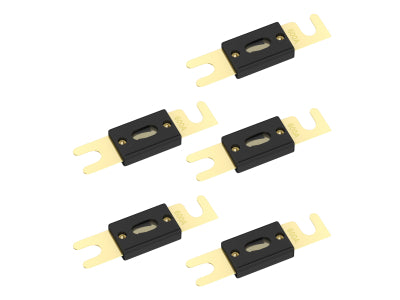
Many DIY enthusiasts and even some professional installers make a critical mistake: they undersize their circuit protection, or worse, rely on standard ANL fuses for equipment that demands dynamic, high-current power.
When a winch stalls under load, or an inverter surges to start a microwave, the current can spike to over 300 or 400 Amps. Without the correct protection, a short circuit doesn't just pop a fuse—it can turn your heavy-gauge wiring into a glowing heating element, leading to a catastrophic vehicle fire in seconds.
In this comprehensive guide, we will walk you through exactly how to select, size, and install a High-Amp Manual Reset Circuit Breaker. This isn't just a safety upgrade; it's a necessary component for any serious automotive or marine electrical system.
Why Standard Fuses Fail with Winches & Inverters?
To understand why you need a circuit breaker, you first need to understand the nature of your equipment.
1. The Problem of "Inrush Current"
Electric motors (like in a winch) and large capacitors (inside inverters) create what is known as "inrush current." When you first activate a winch, it might briefly draw 2-3 times its rated running current. A standard fuse often cannot distinguish between this temporary startup spike and a dangerous short circuit. This leads to "nuisance blowing"—where your fuse pops right when you need your winch the most.
2. The Inconvenience Factor
Imagine you are stuck in a mud pit at night. Your winch pulls hard, and suddenly... silence. You've blown a fuse. Do you have a spare 300A ANL fuse? Do you have the tools to open the fuse holder and replace it in the dark, covered in mud? Probably not.
The Solution: The Circuit Breaker Advantage
A manual reset circuit breaker solves both problems:
- Thermal Tolerance: They are designed to handle brief surges without tripping unnecessarily.
- Reset, Don't Replace: If it does trip, you simply flip the lever back. No spare parts, no tools, no downtime.
- Master Switch Function: High-quality breakers (like our CB-61 series) act as a system disconnect, allowing you to cut power to your winch or inverter when not in use, preventing battery drain and electrical theft.
Choosing Your Weapon: 187 Series vs. Compact Design?
Not all breakers are created equal. At Daier, we offer two distinct styles depending on your installation space and requirements.
Option A: The 187-Series Marine Rated Breaker (Model: CB-61)
- Best For: Main battery banks, large power inverters (>2000W), and heavy-duty marine applications.
- The Design: This is a bulky, heavy-duty unit designed for maximum current flow. It features large 5/16" or 3/8" studs to maximize surface area contact with your cable lugs, reducing resistance and heat.
- Key Feature: The large yellow lever provides a clear visual indication of the circuit status (Open/Closed) and is easy to operate even with gloves on.
- Rating: Available up to 300A.

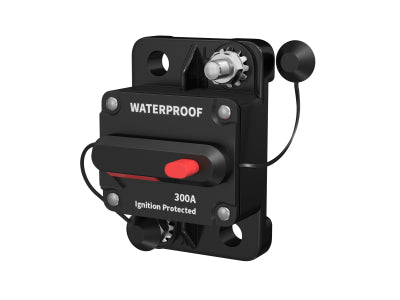
Option B: The Compact Ignition Protected Breaker (Model: CB-03)
- Best For: Under-hood installation, winches, auxiliary lights, and tight spaces.
- The Design: This unit is compact and tough. It is specifically designed to withstand the high heat and vibration of an engine bay.
- Key Feature: Ignition Protection (SAE J1171). This is critical. It means the breaker allows for no spark to escape the casing. This makes it safe to install in gasoline engine bays or boat bilges where fuel vapors might be present—something a standard fuse holder cannot guarantee.
- Rating: Available from 30A to 300A with a simple push-button reset.

Sizing Guide: Doing the Math
Sizing a breaker isn't a guessing game. It is a strict mathematical relationship between your device's power draw and your wire's capacity.
The Golden Rule: The circuit breaker exists to protect the WIRE, not just the device.
Step 1: Calculate the Load
Use the formula: Watts / Volts = Amps.
-
Example: A 3000W Inverter running on 12V.
- 3000W / 12V = 250 Amps.
- Winch Note: Winch manufacturers will list "Max Current Draw" in their manual. A 9500lb winch typically pulls ~350A at full stall.
Step 2: Apply the Safety Margin
Electrical systems shouldn't run at 100% capacity. We recommend a 20-25% safety margin to prevent heat buildup and nuisance tripping.
- 250 Amps x 1.25 = 312.5 Amps.
- Selection: In this case, a 300A breaker is the appropriate standard size.
The Critical Link: Wire Gauge (AWG)
This is the most overlooked step. You cannot install a 300A breaker on a thin wire. If you do, the wire will melt before the breaker ever trips. You must match your wire gauge to your breaker size.
| Circuit Breaker Size | Minimum Recommended Wire Gauge (Copper) |
| 50A - 80A | 6 AWG or 4 AWG |
| 100A - 150A | 2 AWG |
| 200A - 250A | 1/0 AWG ("One-Ought") |
| 300A | 2/0 AWG ("Two-Ought") |
Note: These values are for typical runs under 15 feet. Longer runs require thicker wires to prevent voltage drop.

Step-by-Step Installation Guide
Time Required: 30-45 Minutes
Tools Needed: Socket set, Wire stripper/cutter, Crimping tool, Heat shrink tubing, Multimeter.
Step 1: Location, Location, Location
Mount the circuit breaker as close to the battery as physically possible. Ideally, within 12-18 inches (30-45cm).
- Why? The "Line" side of the breaker (connecting to the battery) is live and unprotected. Minimizing this distance reduces the risk of a short circuit occurring before the protection device.

Step 2: Prepare Your Cables
Cut your positive cable. Strip the insulation and crimp on high-quality copper ring terminals (lugs).
- Pro Tip: Do not solder high-current lugs. The heat from high current can melt solder. Hydraulic crimping is the only safe method for 1/0 or 2/0 AWG cables. Use heat shrink tubing to seal the connection against corrosion.


Step 3: Connect the "LINE" Side
Connect the short cable from your Battery Positive (+) terminal to the stud marked "LINE" (or AUX) on the breaker.
- Torque check: Use a socket wrench to ensure the nut is tight. A loose connection here creates high resistance, which generates heat that can melt the breaker casing.
Step 4: Connect the "LOAD" Side
Connect the long cable running to your Winch or Inverter to the stud marked "LOAD" on the breaker.
Step 5: Grounding
Run your negative cable from the Battery Negative (-) terminal directly to the device. The circuit breaker does not connect to the negative ground wire.
Step 6: Test and Protect
Once wired, engage the lever/button to close the circuit. Test your winch or inverter. Finally, install the rubber terminal covers. This prevents accidental shorts if a wrench slips while working under the hood.
Troubleshooting & FAQs
Q: My circuit breaker trips immediately when I use my winch. Why?
A: This usually means one of three things:
-
Undersized Breaker: Your winch is drawing more amps than the breaker allows. Check the specs.
-
Short Circuit: There is a cut in the cable touching the chassis.
-
Weak Battery: Surprisingly, a weak battery causes higher amperage draw because voltage drops (Watts = Volts x Amps). If Volts go down, Amps go up to compensate. Check your battery health.
Q: Can I mount the breaker upside down?
A: Yes. Daier CB-61 and CB-03 breakers are not orientation-sensitive. However, ensure that water cannot pool around the terminals if mounting in a wet area.
Q: Does ambient heat affect the breaker?
A: Yes. Thermal circuit breakers work by heating up. If you mount them directly onto a hot engine block, they may trip at a lower amperage than rated. Mount them on the firewall or fender well, away from direct exhaust heat.
Conclusion: Peace of Mind for the Trail Ahead
When you are miles from civilization, reliability is everything. A high-quality manual reset circuit breaker is a small investment that protects your expensive electronics, your vehicle, and your safety.
Don't let a $5 fuse ruin a $5,000 trip. Upgrade your system today.
Shop our Full Collection of High-Amp Circuit Breakers - Marine Rated and Ignition Protected.

Deixe um comentário