

Decoding Specifications, Material Durability, and Industry Standards for Automotive, Marine, and Industrial Systems
In the world of electrical engineering, information is the most valuable asset. Whether it is a marine navigation console, an off-road racing dashboard, or an automated industrial control cabinet, the Indicator Light (or Pilot Light) serves as the primary communication bridge between the machine and its operator.
Selecting the right indicator is not merely an aesthetic choice; it is a critical safety and reliability decision. This guide provides a comprehensive technical breakdown of indicator light specifications, the science behind material selection (Metal vs. Plastic), and practical application logic.
 What is the Functional Role of an Indicator Light?
An indicator light is a visual component designed for Status Monitoring. Unlike illumination lights, an indicator transmits specific data through color, brightness, and symbols.
- Logic Mapping: Red implies an emergency or failure; Green implies normal operation; Amber/Yellow implies a warning or a system in transition.
- Safety Criticality: In high-stakes environments like marine engine rooms or heavy machinery, the failure of a single signal light can lead to catastrophic diagnostic errors. This is why the transition from incandescent bulbs to LED technology was mandatory—LEDs offer 50,000+ hours of service and are impervious to the high-frequency vibrations that kill traditional filaments.
Understanding Technical Specifications: The Industry Standards
To build a professional-grade panel, one must adhere to standardized specifications that ensure component compatibility and system longevity.
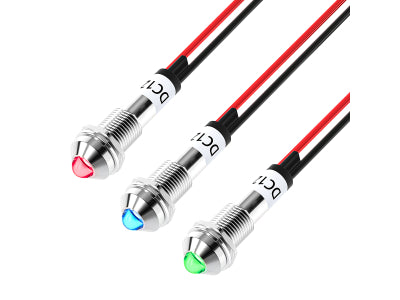
- 6mm & 8mm (Miniature): Specifically used in high-density panels, motorcycle instrument clusters, or compact diagnostic equipment where space is at a premium.
- 12mm & 16mm (Standard): The industry standard for automotive and marine dashboards. These sizes provide the optimal surface area for high-visibility symbols and easy finger-tightening during installation.
- 22mm (Heavy Industrial): The standard for factory automation and large power distribution boards, designed for visibility across a shop floor.
- Voltage Range: Systems typically operate at 12V/24V DC for vehicles and vessels, or 110V/220V AC for industrial grids.
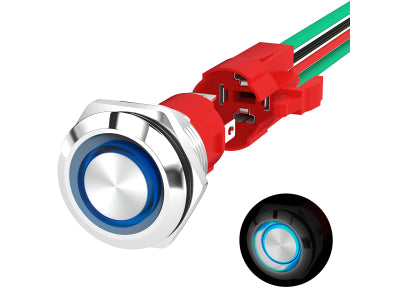
- The "Pre-wired" Advantage: Modern high-quality indicators are often pre-wired and sealed with epoxy. This design provides a massive advantage in marine environments, as it prevents moisture ingress from the back of the panel and eliminates the need for delicate soldering in confined spaces.
 Material Science: Metal vs. Plastic Housings
The debate between metal and plastic is central to component selection. Each material possesses distinct mechanical and chemical properties.
Metal indicators (typically chrome-plated brass or anodized aluminum) are designed for extreme conditions.
- Mechanical Integrity: Metal is highly resistant to impact. In a construction vehicle or a racing cockpit, a dropped tool or flying debris will not crack a metal housing.
- Environmental Resilience: Marine-grade metal finishes (like high-quality chrome) are engineered to resist salt-spray corrosion and UV degradation, which can turn plastic brittle over time.
- Thermal Management: LEDs generate heat. Metal housings act as heat sinks, dissipating thermal energy efficiently, which is vital for indicators mounted in high-temperature engine bays.
- Symbol Precision: Professional metal series utilize laser-etched symbols. These are permanent and will not fade, unlike stickers or printed labels.
 Plastic indicators (typically Polycarbonate or ABS) are the choice for speed and controlled environments.
- The Snap-in Mechanism: Plastic allows for flexible molding. "Snap-in" designs require no mounting hardware; they simply lock into place. This is highly efficient for high-volume manufacturing.
- Dielectric Properties: Plastic is a natural insulator. In complex industrial cabinets with high electrical density, non-conductive housings can prevent accidental short circuits to the panel frame.
- Weight & Cost Dynamics: Plastic is significantly lighter and more cost-effective, making it the logical choice for interior RV panels or consumer electronics.
 Application Scenarios: Where Performance is Non-Negotiable
- Marine & Saltwater Environments: Priority must be placed on IP67/IP68 Waterproofing and Metal Housings. Salt crystals and UV rays act as abrasives and catalysts for material breakdown.
- Off-Road & Heavy Equipment: Priority is Vibration Resistance. A threaded metal housing with a lock washer is far more secure than a snap-in plastic light in a high-vibration environment.
- Control Rooms & Interior Dashboards: Priority is Visibility and Speed. Large plastic lenses provide excellent light diffusion, and snap-in designs allow for rapid assembly.
Technical FAQ: Expert Answers for Better Builds
Q: Does polarity matter when wiring LED indicators?
A: Yes. Most LED indicators are polarized (Directional). Ensure the positive wire (usually red) is connected to the power source and the negative (usually black) to the ground. Reverse polarity will not damage the LED, but it will not light up.
Q: Why do some LEDs fail prematurely in 12V systems?
A: This is usually due to voltage spikes or high resistance caused by poor connections. Choosing pre-wired indicators with high-quality internal resistors ensures the LED is protected against the fluctuating voltages of a running engine.
Q: Can I use an IP65 light on a boat?
A: IP65 is splash-proof but not designed for heavy sea spray or pressure washing. For marine dashboards, an IP67 rating is the professional minimum to ensure longevity against moisture ingress.
Q: What is the benefit of a "Black Bezel" vs. "Chrome Bezel"?
A: This is often functional. Black bezels reduce glare in high-sunlight environments (like a ship's bridge), while chrome bezels provide a classic, high-end look and additional corrosion protection.

Conclusion: Precision Signals Build Better Machines
An indicator light may be a small part of your bill of materials, but it is a massive part of your machine's safety profile. By understanding the specifications and choosing the right material for the mission, you ensure a build that is professional, durable, and safe.
Don't compromise on your build. Explore our Curated Selection of High-Performance 12V LED Indicators.


