

Stop the Wiring Spaghetti. How to Size and Select the Perfect Power Distribution Center for Your Automotive or Marine Build.
Look under the hood of most amateur DIY builds, and you’ll see it: the dreaded "spaghetti wiring." A chaotic bird's nest of inline fuses, mismatched wires, and relay bases zip-tied to whatever was close by. It’s not just ugly; it’s a massive fire hazard and a nightmare to troubleshoot when a light suddenly stops working in the middle of nowhere.
The solution is professional power distribution. You need a centralized hub.
But when you start shopping, you hit a wall: Should you buy a 6-way, an 8-way, a 12-way, or even a massive 24-way box? What is the difference between a simple "fuse block" and a "fuse and relay box"?
Choosing the wrong size or type means you either run out of room immediately, or you waste money and engine bay space on a massive box you’ll never fill.
This comprehensive guide will walk you through exactly how to audit your electrical project, calculate your needs, and choose the perfect power distribution center for your truck, Jeep, RV, or boat.

The Critical Difference: Fuse Block vs. Fuse & Relay Box
Before we count the circuits you need, we must clarify a massive misconception in the automotive and marine world. When people say "fuse box," they are often confusing two very different pieces of equipment.
Understanding this difference is the secret to a professional build.
The Standard Fuse Block (Circuit Protection Only)
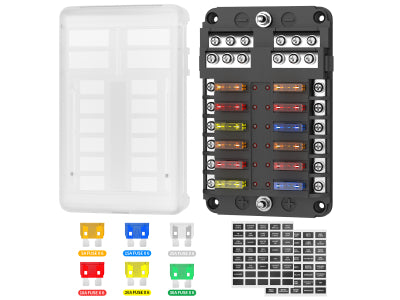
A standard fuse block (like a marine 6-way ATC block) does exactly one thing: it holds fuses. It takes one main power wire from the battery and splits it into multiple fused circuits.
- Best for: Low-amperage, always-on devices, or interior accessories that don't draw much power (e.g., interior LED strips, USB chargers, basic radios).
- The Problem: It cannot safely switch high-power devices on and off.
The Integrated Fuse & Relay Box (Protection + Control)
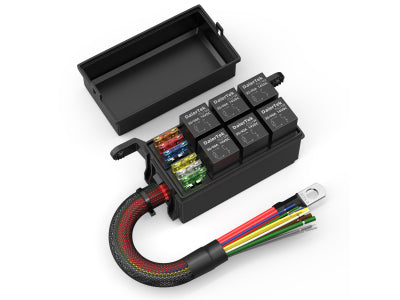
This is what the pros use. An integrated box combines fuses (for safety) and relays (for high-current switching) into one sealed, waterproof enclosure.
- Why You Need It: High-power accessories like LED light bars, air compressors, cooling fans, and winches draw massive amperage. If you run that power directly through your dashboard switches, they will melt and catch fire. Relays take that heavy load.
- The Advantage: Having your fuses and relays housed in a single, dedicated box cleans up your wiring by 80% and provides OEM-level reliability.
The Bottom Line: If you are adding exterior lights, pumps, or motors, you need an integrated Fuse & Relay Box, not just a simple fuse block.
Step 1: The Electrical Audit (How Many "Ways" Do You Actually Need?)
The number of "Ways" (e.g., 6-Way, 12-Way) simply refers to the number of independent, protected circuits the box can handle.
Do not guess this number. Grab a pen and paper and conduct a full electrical audit of your vehicle or vessel.
List every single accessory you plan to install. Categorize them into "Relay Required" (High power) and "Fuse Only" (Low power).
A Typical Off-Road Truck Audit:
- Forward Light Bar (High Power - Relay Needed)
- Ditch Lights (High Power - Relay Needed)
- Rock Lights (Medium Power - Relay Needed)
- Rear Dust/Chase Lights (Medium Power - Relay Needed)
- Air Compressor (High Power - Relay Needed)
- CB/GMRS Radio (Low Power - Fuse Only)
- Accessory USB Ports (Low Power - Fuse Only)
In this scenario, the builder needs a box that can hold at least 5 Relays and 7 Fuses.
Step 2: Choosing Your Size (6-Way vs. 8-Way vs. 12-Way)
Now that you have your list, let's look at the standard sizes and what builds they are best suited for.
The 6-Way Relay Box (The Tactical Upgrade)
The 6-way box is the most popular starting point for weekend warriors. It is compact enough to fit in tight modern engine bays while offering enough capacity for a solid lighting setup.
- Perfect For: ATVs, UTVs, Motorcycles, small center-console boats, or adding a basic lighting package to a Jeep or Tacoma.
- Typical Capacity: 6 Relays and 6 Fuses.
- Daier Recommendation: Look at the 6-Way Fuse and Relay Box. It features a completely sealed design, making it bulletproof for wet off-road conditions.

The 8-Way to 12-Way Relay Box (The Overland Standard)
When your build graduates from "a few lights" to a "mobile command center," you need an 8 to 12-way box. This is the sweet spot for serious off-roaders and mid-sized marine setups.
- Perfect For: Overland vehicles with front/rear/side lighting, fridges, dual air compressors, and communications gear.
- Typical Capacity: Up to 12 Fuses and 6-12 Relays depending on the configuration.
- Daier Recommendation: The 11 Way Fuse and Relay Box is a powerhouse. It manages complex setups without taking up the entire fender well.

The 24-Way Mega-Box (Total System Control)
These are not for the faint of heart. A 24-way (or larger) distribution center is designed to run an entire vehicle's electrical architecture from scratch.
- Perfect For: Custom race cars, complete RV/Camper van electrical overhauls, and large yachts where you are replacing the factory wiring entirely.
- Daier Recommendation: The 24 Way Fuse and Relay Box Kit is the ultimate command center, capable of managing 16 relays and 24 fuses simultaneously.

Step 3: The Golden Rule of Sizing (The "N+2" Formula)
This is the most important piece of advice in this guide. Never buy a box that exactly fits your current list.
In the automotive and marine modification world, projects are never truly "finished." You will always find another light, another pump, or another accessory you want to add next year. If you buy a 6-way box for 6 accessories, you have painted yourself into a corner.
Always use the "N+2" Rule:
Calculate your exact needs today (N), and buy a box that gives you at least two (+2) extra, empty relay/fuse slots for future expansion.
If your audit requires 5 relays, do not buy a 6-way box; buy an 8-way or 11-way box. The minimal extra cost today will save you hours of frustrating rewiring tomorrow.
Beyond the Slots: 3 Features That Mark a Pro-Quality Box
Not all relay boxes are created equal. Once you know your size, look for these three critical specifications:
1. Pre-Wired vs. Unwired (Save 5 Hours of Labor)
Wiring a 12-way relay box from scratch requires crimping over 60 individual terminals. It is exhausting and prone to human error. Pre-wired boxes (like the Daier W1 series) come with high-quality copper pigtails already installed. You simply splice them into your accessories. It turns a 6-hour job into a 1-hour job.

Pre-wired boxes eliminate dozens of crimps, saving time and preventing loose connections.
2. Ingress Protection (IP Waterproof Rating)
If your box is mounted in the engine bay of a 4x4 or the bilge of a boat, it will get wet. Ensure the box has a minimum of an IP65 rating (IP67 is better). Look for silicone gaskets around the lid and rubber seals where the wires exit the bottom.

3. Total Busbar Amperage Limit
A 12-way box might have twelve 20A fuses, but that doesn't mean the box can handle 240 Amps at once. Check the maximum rating of the internal busbar (the main metal strip that supplies power to all fuses). Ensure the total simultaneous draw of all your accessories does not exceed the box's maximum rating.
Conclusion: Build Once, Build Right
Your electrical system is the nervous system of your vehicle. Don't compromise it with messy wiring and overloaded circuits.
By performing a thorough accessory audit, applying the "N+2" rule for future expansion, and choosing an integrated fuse and relay box with the correct IP rating, you are guaranteeing a safe, reliable, and professional-grade build that will withstand the harshest environments.
Ready to clean up your engine bay and take control of your power?
Explore Daier's comprehensive collection of Pre-Wired and Waterproof Fuse & Relay Boxes here. Whether you need a tactical 6-way unit or a massive 24-way distribution center, we have the gear the pros trust.


