


A tool battery can power some 12V accessories when the adapter provides a suitable output. The key distinction is whether the adapter passes battery voltage directly to the device or includes a converter that reduces it to 12V.
An 18V or 20V battery dock does not automatically provide 12V power. For a 12V-only accessory, a suitable step-down converter is needed. An M12 adapter may provide direct battery output, which also needs to fall within the accessory’s accepted voltage range.
Choosing a tool battery adapter for 12V accessories starts with three checks: battery platform, output type and device requirements.

1. Understand What the Adapter Actually Does
Battery adapters can look similar while performing different jobs.
- Direct-output battery dock: connects to the battery terminals; the device must accept the battery’s actual voltage range.
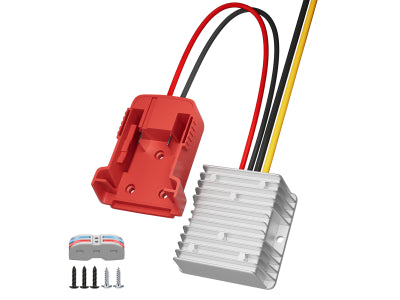
- Battery adapter with step-down converter: provides a lower output voltage from a higher-voltage battery; output and load requirements must match.
- Battery adapter with switch and fuse holder: offers manual control and fuse provision; these features alone do not establish voltage regulation.
A switch controls power. A fuse interrupts excessive current under appropriate fault conditions. A converter changes voltage. These functions should be checked separately.
The DAIER battery adapter collection includes several output types, so battery fit alone is not enough to select a product.
2. Choose the Correct Battery Platform
Start with the exact battery series already available. Milwaukee M18 and M12 use different interfaces. An adapter intended for M18 batteries should not be assumed to accept M12 batteries. DeWalt adapters likewise need to match the battery series listed for the product.
For 12V projects, three DAIER options serve different roles:
- MWK-W1-12V20A: an adapter for Milwaukee M18 batteries with an 18V-to-12V step-down converter.
- De-W1-12V20A: an adapter for compatible DeWalt 20V batteries with a 20V-to-12V step-down converter.
- M12-W1-S: an adapter for Milwaukee M12 batteries with a switch and fuse holder, providing direct battery output.
The first two provide a voltage-conversion path. The M12 model provides a different connection option and should not be treated as an equivalent regulated supply.
3. Match the Output to the Accessory
Check the accessory’s input specification before selecting an adapter. A device marked “12V” may specify an accepted input range in its manual or on its label. That range matters more than the nominal voltage alone.
For an 18V or 20V tool battery connected to a 12V-only accessory, a direct-output dock is unsuitable. A compatible step-down converter is the appropriate product type.
For an M12 direct-output setup, the accessory must tolerate the battery’s changing voltage. A matching nominal “12V” label does not establish that requirement.
Portable work lights and other low-voltage accessories may be suitable candidates when their documented input requirements match the complete supply. Voltage-sensitive electronics, pumps and motor-driven equipment need particular attention to both voltage and current demand.

4. Check Load Demand Beyond the Voltage Label
A converter must support the connected accessory’s operating demand.
The MWK-W1-12V20A and De-W1-12V20A listings specify a maximum output current of 20A. A maximum rating should not be read as a guarantee of continuous operation at that load in every environment.
Check normal operating current, any startup surge and the operating conditions stated for the equipment. Motors and pumps can require more current during startup than during steady running.
Connector ratings, wiring and battery capability also remain part of the power path. The converter’s rating does not increase the capacity of the other components.
Repeated shutdowns, unusual heat or unstable operation are reasons to stop and investigate the setup.
5. Keep Polarity and Circuit Protection Separate
Confirm positive and negative connections at both the adapter output and accessory input. Connector shape alone does not establish polarity.
Connections should be secure, insulated and protected from movement that could pull wires loose. Remove the battery before assembling or changing connections.
A supplied fuse is not automatically the correct choice for every accessory. Fuse selection depends on the circuit, wiring and equipment requirements. A larger fuse should not be installed simply to prevent repeated fuse opening.
The 12V fuse box buying guide explains protection and distribution choices for projects that extend beyond one accessory.

6. Understand Battery Protection and Runtime Limits
The two DAIER step-down adapter listings describe under-voltage protection, along with other protective functions. However, the listings do not specify a cutoff threshold or fully explain battery over-discharge protection.
That distinction matters: a listed converter protection feature does not establish how every compatible battery will behave in an external adapter setup.
Follow the battery and adapter instructions, and disconnect the battery when the setup is not in use. Avoid leaving the system running unattended.
Runtime also varies with battery capacity, accessory power demand, conversion losses, temperature and cutoff behavior. A larger battery capacity does not support a universal runtime claim.
A voltage display can provide useful information, but it is not a complete measure of remaining runtime. The voltmeter versus battery monitor guide explains that limitation.
7. Decide Whether Portable Tool-Battery Power Fits the Task
A tool battery adapter can make sense for a temporary, portable accessory setup when a compatible battery is already available.
For example, a suitable work light used during a vehicle repair may benefit from a portable supply. The decision still depends on the light’s electrical requirements and the selected adapter.
A permanent vehicle, RV or marine installation involves additional considerations, including mounting, environmental exposure, charging and circuit protection. A portable battery adapter should not automatically replace a dedicated installation.
For projects involving several loads or long periods of operation, evaluate a complete power system rather than adding accessories until the adapter reaches its limit.

8. Related DAIER Products
Milwaukee M18 to 12V — MWK-W1-12V20A
Milwaukee M18 Battery Adapter with Step-Down Converter
A platform-specific option for projects using compatible M18 batteries and requiring conversion to 12V. The listing specifies a maximum 20A output; accessory demand and operating conditions still need to suit the complete setup.
DeWalt 20V to 12V — De-W1-12V20A
DeWalt 20V Battery Adapter with Step-Down Converter
A corresponding step-down option for compatible DeWalt 20V batteries. Select this model by battery platform and output requirements, rather than by connector appearance alone.
Milwaukee M12 Direct Output — M12-W1-S
Milwaukee M12 Battery Adapter with Switch and Fuse
A direct-output option with manual switching and a fuse holder. It suits projects only when the connected equipment accepts the battery’s actual output range; it is not presented as a regulated 12V converter.
9. Frequently Asked Questions
Does a battery adapter always reduce voltage?
No. Some adapters provide direct battery output. Voltage reduction requires a suitable converter.
Does a fuse protect against excessive voltage?
No. A fuse serves an overcurrent-protection role. It does not convert 18V or 20V battery output to 12V.
Can a tool battery be charged through the adapter’s output wires?
Do not use the output leads as a charging connection unless the product is explicitly designed for that purpose. Charge the battery with a charger approved for the battery system.


