

Kit de verrouillage du générateur




18 items


Filtrer


Shopping Experience
Support 24/7
Online 24 Hours
Fast Delivery
Any Orders
Return Policy
30 Days Hassle-Free
Payment Method
Secure Payment
+
View more
Frequently Asked Questions
A generator lockout kit is a safety device designed to prevent "backfeeding" by mechanically ensuring that the main breaker and the generator breaker cannot be in the "ON" position at the same time. This prevents electricity from the portable generator from flowing back into the utility grid, which could endanger utility workers, while also protecting the household electrical system from damage when the grid power is restored.
Compatibility depends entirely on the brand, model, and physical layout of the main electrical panel. These kits are specifically engineered for major brands, including Square D (QO/Homeline), Eaton (Cutler-Hammer), Siemens, and General Electric (GE). When selecting a kit, it is critical to verify:
· The spacing between the main breaker and the branch breakers (e.g., 1-1/4" or 2-1/4" spacing).
· The amperage of the main breaker (e.g., 100A, 150A, or 200A).
· The specific model series of the panel.
· The spacing between the main breaker and the branch breakers (e.g., 1-1/4" or 2-1/4" spacing).
· The amperage of the main breaker (e.g., 100A, 150A, or 200A).
· The specific model series of the panel.
Yes. When properly installed, mechanical interlock kits are a code-compliant and cost-effective alternative to expensive transfer switches. They meet the requirements of the National Electrical Code (NEC) by providing a permanent, mechanical safety barrier that prevents the simultaneous closure of two power sources.
These lockout kits are typically manufactured from high-grade CNC-machined aluminum alloy or stainless steel. These materials are chosen for their high tensile strength and natural resistance to corrosion and oxidation, ensuring that the sliding mechanism remains smooth and functional for years, even in humid or unconditioned garage environments.
While the installation is straightforward, it involves working inside the main electrical panel and drilling holes into the panel cover. Most kits include the necessary professional-grade drill bit and mounting hardware. While many experienced DIYers perform the installation, it is strongly recommended to consult a licensed electrician to ensure all safety protocols are followed and the generator breaker is correctly wired to an inlet box.
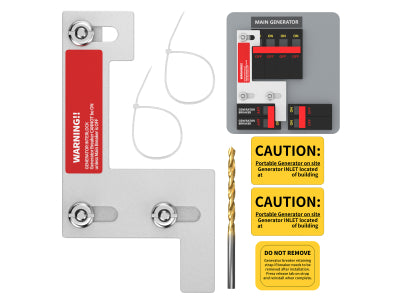
A complete kit usually includes the primary interlock sliding plates, specialized mounting screws and nuts, and a high-quality drill bit. Crucially, kits also include mandatory safety warning labels and tags (such as "Main Breaker Interlock" and "Generator Inlet" stickers). These labels are required by inspectors to clearly identify the backup power procedures and ensure the system is operated safely during a power outage.


